
"A Language to Live By"

An Interview with Pendo Galukande

Pendo Galukande is from Kampala, Uganda and was part of the original ground team in 2023 organizaing the Externship and especially the "Hold Me Tight" Couples workshop with church and community leaders, an area of great passion for her. Pendo has taken that passion to the MFT doctoral program at Michigan State University where she is currently working today. Carlota took a few moments during the Thanksgiving holiday
to sit down and explore Pendo's passion for community work and EFT.
Interviewer: Hi Pendo, how are you?
Pendo: Hello Carlota, it’s been so long. I’m doing well, how are you?
Interviewer: I know… I’m so happy we get this time to chat. It’s so good to see you. I’m doing well too.
Pendo: Me too!
Interviewer: Thank you for your time and your generosity. I’m sure this will inspire many people and offer insight into the work we’re doing at Conexa.
Pendo: I would love that. Yes. I’m happy to be here and to share my experience.
Interviewer: Let’s get to it then. So the first question is: How did you first become involved with Conexa?
Pendo: So funny that when you ask that question, initially I was like, “Yeah, how I found myself in the middle of Con…” I don’t remember exactly how it happened, but I think it was that Ronald must have contacted me. And he and I had met in 2021. I was speaking on attachment at the Uganda Counseling Association and explaining how attachment is relevant in couple therapy. Ronald and I met before the talk and after the talk—he was like, “Why are you going to study Counseling education and supervision? You’re a marriage and family therapist through and through.”
The thing is I’d written a book and given some talks, and this is how the therapists in Uganda Counseling Association got to know about this work. So after the talk Ronald asked me, “Why are you going to do a PhD in counselor education and supervision?” And I was like, “I’ve looked everywhere for a family-related PhD. I cannot find anything.” Then he said, “Well, which state are you going to be in?” I said, “Virginia Beach.” And he said, “Then check out Virginia Tech.”
So I went back, I’d already paid school fees and everything, and he’s like, “You know, maybe you go on and do your PhD in counselor education supervision and eventually do your research in marriage and family… now that you’ve already… it seems like you’re all in.” But I went back and I couldn’t shake the thought that maybe I was making a mistake. So I started to speak to my professors one-on-one, and each of them said, “If you’re looking for more clinical skills and to go deeper into marriage and family, you’re not going to get what you want in this PhD that you’ve signed up for.”
So within a month, I dropped out. I applied to Virginia Tech, and then I looked for him and applied to Michigan State. Along the way is when he told me, “Oh, there’s this group of people…” I think he and I had talked about EFT and how much we like it. He went ahead and organized everything and told me it was coming, and I was just like, “Hallelujah,” because I had thought it was the biggest impossibility, like a far-fetched dream. I’d already been asked by the UCA to bring EFT training to Uganda and I had reached out to Sue Johnson and to Leanne Campbell. Leanne had spoken to a group of people in Uganda, but we hadn’t gotten anywhere near a training. So when Ronald said this, it was just fantastic.
So yeah, that’s how I got involved. And then he said, “Can you manage the Hold Me Tight side of things? Can you arrange the logistics for that?”
Interviewer: You were all in.
Pendo: Yes, I was in before I was completely in.
Interviewer: I’m curious, what made you want to be in this project? What about this project called you to be like, “I want to do this. I want to get involved”? Because at the end of the day, we were all volunteers, and you were going through a lot of work already. So what part of you was saying, “This is my calling. I want to do this project”?
Pendo: That goes way back. I am just a relational human being. That’s how I am. I think my sister is the same way. And parents probably were very much into affection and love and all that. And I had gone through a lot of personal trauma in that both my parents died before I was six. And it was sudden death, completely unexpected. My dad was poisoned. Then three years later, my mom was in a car accident. So coming from that very close, bonded family to suddenly you’re orphans, and just the attachment pain that I experienced…
Then I was adopted. We were adopted, all three of us, into a family. And because I was so shut down, like, I didn’t cry. I was beyond sad. I was beyond heartbroken., I was just frozen. So the adults thought, “Oh, she’s too young. She’s only six. She probably doesn’t know her mom has died. If we keep quiet, she will forget about it.” Which was absolutely furthest from the truth. I was so aware my mom had died, and I needed all the comfort I could get, but I now could not be comforted for all those years growing up because the adults thought I didn’t know, and so they could not comfort me, because comforting me would mean that they are admitting that my mom died. So they just tried to absorb me into the adoptive family.
So it’s like I had this all through my life, and even going through counseling school, there was not a language that could articulate my trauma. But coming into EFT, I was like, “Oh gosh. Here is a language to explain everything that I have gone through and explains my life and what I’m looking for and I was so inspired by EFT.” So for me, there was no question. I was already sold.
In my master’s program, when I did the course unit, I think it was called Couples Therapy, we did Gottman, Hope Focused Couple Therapy and Emotionally Focused Couple Therapy. When I read the EFT book, I read it from cover to cover. I was bouncing off the walls, just too excited to have discovered this thing that explained life and relationships. And that’s why, going back, I did learn a lot of other things in my master’s, and you’ll see that in my book there’s several chapters about other, not modalities necessarily, but other useful tools and conceptualizations of relationships.
When I went back home, I felt like I needed to bring back this language of attachment and to share about it. And like I said, I really wanted EFT. I hadn’t done the externship. I’d only been taught EFT in a theoretical sense. I’d read the textbook cover to cover. I went back home, read it again. But it wasn’t sufficient to really grasp the skills. As you know, EFT is very nuanced. Even now; how many years is it now? It’s two years since I did the externship and five years since I started reading and being taught theoretically, and I still can’t say that I am fully competent. It takes a while to get the skills.
So, as I spoke about it I realized all the other therapists in Uganda were dying to have this. And everyone in Uganda that I spoke to, I think, recognized this new language, and it resonated with people when I spoke to them. So they were ready. They were ready for this systemic intervention.
Interviewer: Amazing. I love it. Thank you for sharing. How was the EFT training for you and how did you see it impact all the people?
Pendo: I think it was better than I expected. I think what the team put together, Mark, Ronald, their leadership was incredible. I think that team was especially special. It was people who don’t only practice it but live relationally as EFT, or attachment-sensitized practitioners or human beings.
There was a lot to be said for how open people were to relationship, how affirming they were, the intentionality about having all those meetings about culture. They were really meaningful. Respect for leadership—a very careful community entry. It blew my mind. It went way beyond what I was thinking. When I was thinking EFT training, I had thought, “Just get an EFT trainer. They come and they teach us and they go.” I didn’t anticipate building relationship and thinking so deeply about my culture and other cultures and just creating an entire community and all these relationships that are going on up to today.

Interviewer: You learned a lot, not only from the training but from the process and from the people that brought the training.
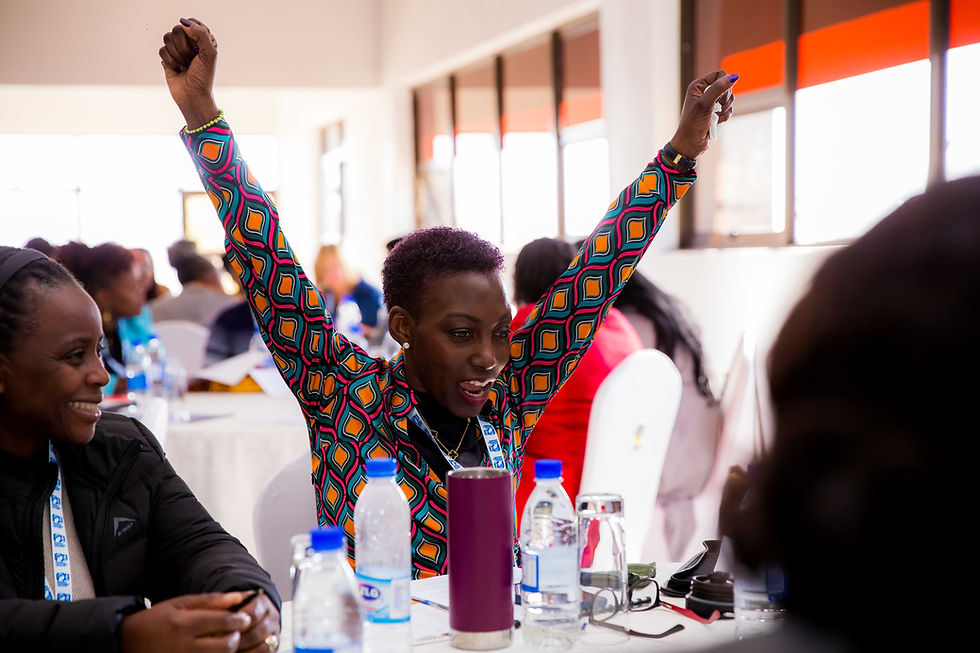
Pendo: Absolutely. And then when both, Dr. Guillory and Dr. Lesch, just presenting in a very, very sensitive, culturally attuned way, it was amazing. And of course all the Ugandan fun. We were given the liberty to add in our dances, our jokes and whatnot, and it was celebratory. It was a fantastic… I don’t know that I’ve ever been part of such a fun training in any field. And I’ve been in other fields before, you know, I started off in zoology, I went into health systems management, and now in counseling. But this was just so special. It was beyond special.
Interviewer: I agree. It was amazing. What do you see as the biggest needs or opportunities for relational therapy in East Africa?
Pendo: That is a huge question. Before we implemented EFT, it was very clear in my mind, oh yeah, we just need to go and take EFT and train many people and that’s it. However, now that I am doing my PhD, I’m not only a clinician now, I need to think also as a scholar-implementer. I've become more aware that we need to be culturally conscious, and that whatever model we take fits with the culture.
So there's a lot of adaptation that needs to go on, and many assumptions we've made need to be explored and understood. In many ways, the researcher in me now is at the forefront. We need to understand dyadic relationships and how the attachment dynamic plays out in Uganda. I’m also thinking group, that if we are going to implement EFT on a big scale, we’re going to have to think of groups, how to pass it on in large groups, but also, how do you do that when there's such a diversity in language?
And then trauma is another thing that is at the forefront of my mind. When there is a lot of trauma, emotional vulnerability may be difficult because you have less emotional regulation. So I'm thinking of going back to the drawing board and developing community entry that does a lot of awareness campaigns on emotions, their use, emotional regulation, attachment—a lot of awareness first and foremost. Then basically emotional regulation skills, then maybe some trauma therapy, and build on that our relational work.
I’m saying it in that order, but it may be implemented differently. I don’t think everybody has to wait until all the awareness is done before we do emotional regulation. But those are some of the things I’m thinking at this stage. A lot more awareness so that we even have the language. How are you going to convince people to get into something which maybe they’ve never heard of, they’ve never considered, and they don't even have a language to have a conversation over this particular issue?
So awareness is my big thing right now. Can we break down attachment and all that emotional language into metaphors and conversations that make sense locally and spread that, and then find ways of passing on skills as well, or looking for skills that already exist. I shouldn't assume that there's nothing. In one of the research studies we've just done, Elmien, Ronald, and Rosco, we talked about the fact that Africa has a very rich relational history and that there are things that work. It’s just that those things have not been documented. So going back and understanding that is critical.
Somewhere along the way you mentioned my research. My own area of inquiry right now is adult attachment. Can we assume that romantic relationships follow an adult attachment relational pattern? Do men and women go into marriage to seek for their attachment needs to be met—comfort and proximity and safe haven and secure base? Or do individuals get those needs met by their family of origin, and then come into the marriage for other needs, maybe more survival needs?
So I would like to get an understanding: what does marriage and romantic relationships mean in Uganda? And of course it’s not going to be one thing. We are well aware that there’s a lot of influence of the West, and people in the urban centers are going to think differently—people in cities are going to think differently from those in the rural area or I expect they will be less west-acculturated. But trying to position Uganda on the continuum so that there’s an understanding: this is generally where people are. And then, when we are creating interventions, just tweaking them so that they’re more relevant, appropriate to the culture.

Interviewer: You shared so much, and what really stood out to me is how you highlighted the need for true cultural adaptation. Many people assume EFT can just be applied anywhere, but your reflections show how much thoughtful work still needs to be done for it to fit the realities, languages, and relational patterns here.
Pendo: Yeah, there is a lot of work that can be done.
Interviewer: So what are your hopes for the development of EFT in Uganda?
Pendo: I think right now I honestly feel that we need, if it was possible, resident supervisors who can train. Well, let me not put the bar so high, because if I say resident supervisors, maybe I’m asking for an impossibility. But we need supervision badly, badly, badly.
One person who's really good at EFT told me, she’s a trainer now, it took her 10 years to master EFT, and she was based here in the States where they have access to supervisors and deeper trainings and all that. I’m not saying everyone’s going to take 10 years, but that just showed how these are really early days. And we want people to become competent. The training has to continue maybe for at least 10 years, and to have some EFT-certified people, EFT supervisors, and EFT trainers.
Because English may be a national language, but it’s not the heart language. Our traditional languages are the heart languages. If you’re ever in a church and they’re singing in English and then they switch to a traditional language, you’ll see the shift in atmosphere. Suddenly the atmosphere will change and it becomes a lot more charged, because those are the heart languages. That is how we convey meaning.
So training in English is great, but it doesn't do as much as training in the local languages, where somebody who's really close to the culture can speak in the local languages and use appropriate metaphors and all that. So EFT has a long journey—really, to continue training and to get some critical people at least certified, and then some supervisors, and then that is how it will grow from that core group.
Interviewer: Everything you said about supervision, language, and developing culturally rooted trainers really highlights how much more we need to understand. So building on that, I wanted to ask: What areas of EFCT would you like to explore further in future research? And could you share a bit about your research interests and your doctoral program?”
Pendo: Yeah. Maybe I should touch that briefly. I'm also very much into EMDR, which is right now the number one therapy recommended for treatment of trauma and recognized by WHO and the Trauma Institute for children, I’ve forgotten the name of it. There is one paper talking about integration of EMDR and EFT. I know a lot of EFTs may not want to integrate models, but I think that may be critical for our work in Uganda and the African continent. That is one area that I think about. Remember that we met with Carmen Morrison and I love their model. I think they talked about doing trauma therapy, EFT therapy, and just doing this in communities. We talked about going to churches and maybe putting this within discipleship programs.
For me, because the churches are already doing… they already have so many millions and millions of people coming to them, you just have to train those same people to do the work, and then that’s how the work will be sustained. So looking for a way to sustain the work and a way to grow the work is really to train people who are already doing the relational work, and that happens to be mostly religious leaders.
I know that it's heavily biased towards Christianity, but that’s who’s been doing most of the relational work. We’d have to wrap our heads around what about the non-Christians, like the Muslims. I asked some of my Muslim friends if they had an equivalent program in the mosques, and they said that they didn’t. So, we do have therapists still, and we’ve tried to walk alongside them in getting trained and keeping them in touch with resources.
My hope is that we’ll find another way for people who are not in the Christian circles. But for me, if there’s already a whole mechanism that is nationwide, that already exists in the church, I think we should take advantage of that. And we did start, at that training we had a Pastor, and a few people who are involved in that. When we held a Hold Me Tight workshop as well, there were quite a number of leaders who heard and experienced the power of EFT. So we just need to continue cultivating. It shouldn’t stop. It should continue.
Interviewer: Yeah, absolutely. I love how you’re thinking not just about integration between models like EMDR and EFT, but also about integration at the community level—working with churches, leaders, and existing structures. It’s such a powerful way to make the work sustainable and inclusive, even while continuing to figure out pathways for non-Christian communities.
Pendo: Thank you.
Interviewer: You’re amazing, Pendo. Thank you so much for your time. Have a wonderful rest of your day.
Pendo: Thank you for interviewing me. And Happy Thanksgiving.
Interviewer: Happy Thanksgiving. Goodbye.


Comments